Manned Flight n°: 104 |
Earth orbit Flight n°: 101 |
USA manned Flight n°: 47 |
Launch, orbit & landing data:
| Designation | 15641 / 85028A |
| Launch date - time | 12 Apr 1985 - 13:59:05 UT |
| Launch site | KSC, LC39A |
| Launch vehicle |
Space Shuttle |
| Orbiter | Discovery OV-103 (#4) |
| Primary payload | Anik C1/SYNCOM IV-3 |
| Mass (kg) | |
| Call Sign | |
| Earth orbit: |
| - Perigee / Apogee | km |
| - Inclination | 28.5° |
| - Period | min |
| Landing date - time | 19 Apr 1985 - 13:54:28 UT |
| Landing location | KSC, Runway 33 |
| Flight Duration (d:hr:min) | 6d 23h 55m |
| Nbr orbits | 110 |
|

|
7 astronauts
Flight Crew
| Nr. |
Surname |
Given name |
Job |
Duration |
| 1 |
Bobko |
Karol Joseph |
CDR |
6d 23h 55m |
| 2 |
Williams |
Donald Edward |
PLT |
6d 23h 55m |
| 3 |
Seddon |
Margaret Rhea |
MSP |
6d 23h 55m |
| 4 |
Hoffman |
Jeffrey Alan |
MSP |
6d 23h 55m |
| 5 |
Griggs |
Stanley David |
MSP |
6d 23h 55m |
| 6 |
Walker |
Charles David |
PSP |
6d 23h 55m |
| 7 |
Garn |
Edwin Jacob "Jake" |
PSP |
6d 23h 55m |
Mission details:
Launch from Cape Canaveral (KSC); landing in Cape
Canaveral (KSC); deploying of communications satellites TELESAT-I (ANIK
C-1) and SYNCOM IV-3 (LEASAT-3); Senator Garn first politician in space;
Walker (McDonnell) worked again on the Electrophoresis-experiment; Hoffman
and Griggs peformed a not planned spacewalk (3h 08m) to attach Flyswatter
devices to remote manipulator system; LEASAT-3 spacecraft sequencer failed
and the antenna was not deployed and the perigee kick motor did not start;
mission extended two days, but the sequencer still failed; landing was
problematic with extensive brake damage.
12 April 1985
13:55 GMT.Payload: Discovery F04 / Anik C1[PAM-D] / Syncom-4 3 /Orbus. Mass: 16,249 kg. Perigee: 445 km. Apogee: 535 km. Inclination: 28.5 deg. Period: 94.4 min.
 | STS-51-D - Astronaut Rhea Seddon sits down to a meal in the middeck - Credit: NASA. |
Payloads: Telesat (Canada communications satellite)-I with Payload Assist Module (PAM)-D deployment, Syncom IV-3 communications satellite deploy-ment with its unique stage (unique stage failed to ignite), Continuous Flow Electrophoresis (CFES), Phase Partitioning Experiment (PPE), student experiments, two getaway specials (GAS) Informal science studies (Toys in Space).
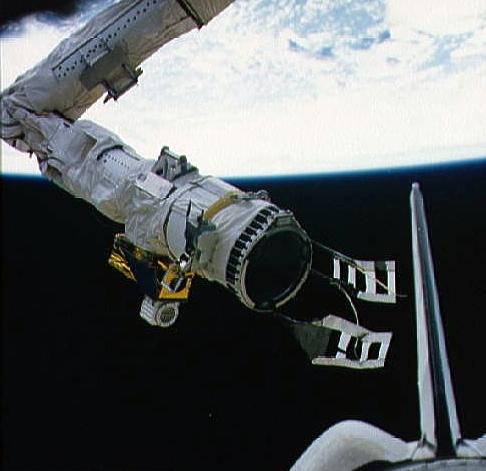
 | STS-51-D - End effector of the Discovery's RMS with tools moves toward Syncom-IV - Credit: NASA. 30,269 bytes. 482 x 482 pixels. |
Orbits of Earth: 109. Distance traveled: 4,650,658 km. Orbiter Liftoff Mass: 113,802 kg. Orbiter Mass at Landing: 89,816 kg. Payload to Orbit: 16,249 kg. Payload Returned: 6,009 kg. Landed at: Runway 33 at Kennedy Space Center, Florida. Landing Speed: 370 kph. Touchdown miss distance: 499 m. Landing Rollout: 3,179 m. EVA: Jeffrey Hoffman and David Griggs, duration, 3 hours, 10 minutes.
 | STS-51-D - End effector of the Discovery's RMS with tools attached - Credit: NASA. 27,609 bytes. 486 x 486 pixels. |
NASA Official Mission NarrativeMission Name: 51-D (16)
DISCOVERY (4)
Pad 39-A (28)
16th Shuttle mission
4th Flight OV-103
Extended mission
5th KSC landing
Crew:
Karol J. Bobko (2), Commander
Donald E. Williams (1), Pilot
M. Rhea Seddon (1), Mission Specialist 1
Jeffrey A. Hoffman (1), Mission Specialist 2
S. David Griggs (1), Mission Specialist 3
Charles D. Walker (2), Payload Specialist 1
Sen E. Jake Garn (1), Payload Specialist 2
 | STS-51-D - Syncom-IV (LEASAT) satellite - Credit: NASA. 32,251 bytes. 419 x 419 pixels. |
Milestones:
OPF - Jan. 28, 1985
VAB - March 23,1985
PAD - March 28, 1985 Payload:
LEASAT-3,ANIK-E2,CFES(6),AFE,PPE/SAS,SSIP(x2),GAS(x2)
Mission Objectives:
Launch:
April 12, 1985, 8:59:05 a.m. EST. Launch set for March 19 rescheduled to March 28 due to remanifesting of payloads from canceled mission 51-E. Delayed further due to damage to orbiter's payload bay door when facility access platform dropped. Launch April 12 delayed 55 minutes when ship entered restricted solid rocket booster recovery area. Launch Weight: 250,891 lbs.
Orbit:
Altitude: 285nm
Inclination: 28.5 degrees
Orbits: 110
Duration: Six days, 23 hours, 55 minutes, 23 seconds.
Distance: 2,889,785 miles
 | STS-51-D - Astronaut S. David Griggs waves to Orbiter during EVA - Credit: NASA. 37,839 bytes. 618 x 618 pixels. |
Hardware:
SRB: BI-018
SRM: L017(HPM)
ET : 18/LWT-11
MLP : 1
SSME-1: SN-2109
SSME-2: SN-2018
SSME-3: SN-2012 Landing:
April 19, 1985,8:54:28 a.m. EST, Runway 33, Kennedy Space Center, Fla. Rollout distance: 10,430 feet. Rollout time: 63 seconds. Extensive brake damage and blown tire during landing prompted landing of future flights at Edwards Air Force Base until implementation of nose wheel steering. Landing Weight: 198,014 lbs.
 | STS-51-D - Astronaut Rhea Seddon works on flyswatter-like snagging device - Credit: NASA. 25,837 bytes. 319 x 319 pixels. |
Mission Highlights:
TELESAT-l (ANIK C-1) communications satellite deployed, attached to Payload Assist Module (PAM-D) motor. SYNCOM IV-3 (also known as LEASAT-3) deployed. but spacecraft sequencer failed to initiate antenna deployment, spin.up and ignition of perigee kick motor. Mission extended two days to make certain sequencer start lever in proper position. Griggs and Hoffman performed space walk to attach Flyswatter devices to remote manipulator system. Seddon engaged LEASAT lever using remote manipulator system but post deployment sequence did not begin. Other payloads: Continuous Flow Electrophoresis System (CFES) III, flying for sixth time; two Shuttle Student Involvement Program (SSIP) experiments; American Flight Echocardiograph (AFE); two Get Away Specials; Phase Partitioning Experiments (PPE); astronomy Photography verification test; medical experiments and `toys in space, an informal study of the behavior of simple toys in weightless environment, with results to be made available to school students.
Astrophilately covers:
 STS-51D launch cancel. |
|
Ref.: #1, #6, #7, #8, #16, #411 - update: 25.05.25
|
Home |