Manned Flight n°: 185 |
Earth orbit Flight n°: 182 |
USA manned Flight n°: 105 |
Launch, orbit & landing data:
| Designation | 23762 / 96001A |
| Launch date - time | 11 Jan 1996 - 09:41:00 UT |
| Launch site | KSC, LC39B |
| Launch vehicle |
Space Shuttle |
| Orbiter | Endeavour #10 (OV-105) |
| Primary payload | Spartan-206 |
| Mass (kg) | |
| Flight Crew | Duffy, Jett, Chiao
Scott, Wakata, Barry |
| Earth orbit on : |
| - Perigee / Apogee | km |
| - Inclination | 28.45° |
| - Period | min |
| Landing date - time | 20 Jan 1996 - 07:41:41 UT |
| Landing location | KSC, Runway 15 |
| Flight Duration (d:hr:min) | 8d 22h 01m |
| Nbr orbits | 142 |
|
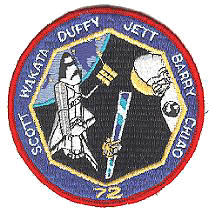
|
Crew
| Nr. |
Surname |
Given name |
Job |
Duration |
| 1 |
Duffy |
Brian |
CDR |
8d 22h 01m |
| 2 |
Jett |
Brent Ward, Jr. |
PLT |
8d 22h 01m |
| 3 |
Chiao |
Leroy |
MSP |
8d 22h 01m |
| 4 |
Barry |
Daniel Thomas |
MSP |
8d 22h 01m |
| 5 |
Scott |
Winston Elliott |
MSP |
8d 22h 01m |
| 6 |
Wakata |
Koichi |
MSP |
8d 22h 01m |
Mission details:
Launch from Cape Canaveral (KSC); landing on Cape
Canaveral (KSC); Space Flyer Unit from Japan was captured and brought to
Earth; EVA by Chiao and Barry on 15.01.1996 (6h 9m) and by Chiao and Scott
on 17.01.1996 (6h 41m) to test tools and hardware that will be used in the
assembly of the ISS; crew also deployed and retrieved the
OAST-Flyer.
11 January 1996
09:41 GMT. Duration: 8.92 days.Agency: NASA-JSC. Payload: Endeavour F09 / OAST / FSU. Mass: 6,510 kg. Perigee: 302 km. Apogee: 310 km. Inclination: 28.5 deg. Period: 90.6 min.
Summary: Deployed and retrieved OAST Flyer; retrieved SFU Space Flyer Unit. Beside the two satellite retrievals, the mission included two spacewalks. Deployed and retrieved OAST Flyer; retrieved SFU Space Flyer Unit. Beside the two satellite retrievals, the mission included two spacewalks. Endeavour completed its rendezvous with the Space Flyer Unit satellite on Jan 13. The SFU successfully retracted its solar panels, but failed to latch them, so the decision was made to jettison them. The first panel was ejected at 0935 GMT and the second at 0947 GMT. At 1057 GMT the RMS 303 robot arm was used to grapple SFU, and it was berthed in Endeavour's payload bay at 1139 GMT. SFU carried science and technology experiments for Japan's National Space Development Agency.
Endeavour then lowered its orbit to 302 x 311 km x 28.5 deg. The OAST-Flyer (Spartan 206) satellite was released using the RMS arm at 1132 GMT on Jan 14. OAST-Flyer carried an experiment to measure contamination caused by spacecraft outgassing, and a test of a laser-fired explosive separation device to make sure the device doesn't go off accidentally in sunlight. It also carried an amateur radio experiment.
Astronauts Leroy Chiao and Daniel Barry carried out a spacewalk on Jan 15. The airlock was depressurized at 0525 GMT, and NASA declared the EVA in progress at 0535 GMT. The hatch was opened at 0540 GMT. Chiao and Barry tested out Space Station equipment including a portable work platform and a rigid umbilical truss for carrying electrical cables and fluid lines. The astronauts returned to the airlock at 1130 GMT and closed the hatch 3 minutes later, returning their suits to orbiter power and repressurizing the airlock at 1144 GMT. NASA's official time for the walk was 6h 9m 19s.
On Jan 15-16 the Shuttle carried out a series of rendezvous burns to approach the OAST-Flyer Spartan, and on Jan 16 at 0947 GMT Wakata grappled the satellite with the RMS arm.
The second spacewalk to test out Space Station tools and equipment was performed by Chiao and Winston Scott. It started a little behind schedule, with depressurization at 0534 GMT on Jan 17, and hatch opening at 0554. The spacewalk ended at 1234 GMT, for a duration 6h 53m 41s. Scott tested out the thermal modifications to the spacesuit by standing in shadow on the Spartan Flight Support Structure while the Orbiter was turned to make the payload bay as cold as possible.
Endeavour closed its payload bay doors early on Jan 20, firing its braking rockets at 0641 GMT and reentered to a night-time landing on runway 15 at Kennedy Space Center at 0742 GMT on Jan 20.
Orbits of Earth: 142. Distance traveled: 5,954,572 km. Orbiter Liftoff Mass: 112,182 kg. Orbiter Mass at Landing: 98,549 kg. Payload to Orbit: 6,510 kg. Payload Returned: 10,084 kg. Landed at: Concrete runway 15 at Kennedy Space Center, Florid. Landing Speed: 342 kph. Touchdown miss distance: 1,032 m. Landing Rollout: 2,459 m. EVA: EVA No. 1, Leroy Chiao and Daniel T. Barry, 6 hours, 9 minutes; EVA No. 2, Leroy Chiao and Winston E. Scott, 6 hours, 53 minutes. Chiao and Barry evaluated a new EVA workstation, a movable stanchion that provides stability for astronauts and holders for tools, a flexible foot restraint, and a rigid umbilical that may be used on the International Space Station to hold fluid and electrical umbilicals in place. Payloads: Space Flyer Unit (SFU) retrieval; Office of Aeronautics and Space Technology (OAST) Flyer; Shuttle Solar Backscatter Ultraviolet (SSBUV/A; Shuttle Laser Altimeter (SLA) 01/ Getaway Special (GAS)(5); Extravehicular Activity Development Flight Test (EDFT) 03; Physiological and Anatomical Rodent Experiment (PARE)/National Institutes of Health (NIH) Rodents (R) 03; Protein Crystal Growth (PCG) Single-Locker Thermal Enclosure System (STES) 04; Commercial Protein Crystal Growth (CPCG) 08; Space Tissue Loss (STL)/National Institutes of Health (NIH) Cells (C) 05. Chiao and Scott evaluated a utility box designed to hold avionics and fluid line connections on the space station, an on-orbit-installed slidewire to which tethers can be connected, thermal improvements of space suits, and a wrist-mounted computer called the electronic cuff checklist. They also took measurements of the forces induced by work.
External links:
Astrophilately covers:
 STS-72 launch cancel KSC. |
|
Ref.: #7, #8, #16, #127, #411 - update: 27.11.2025
|
Home |