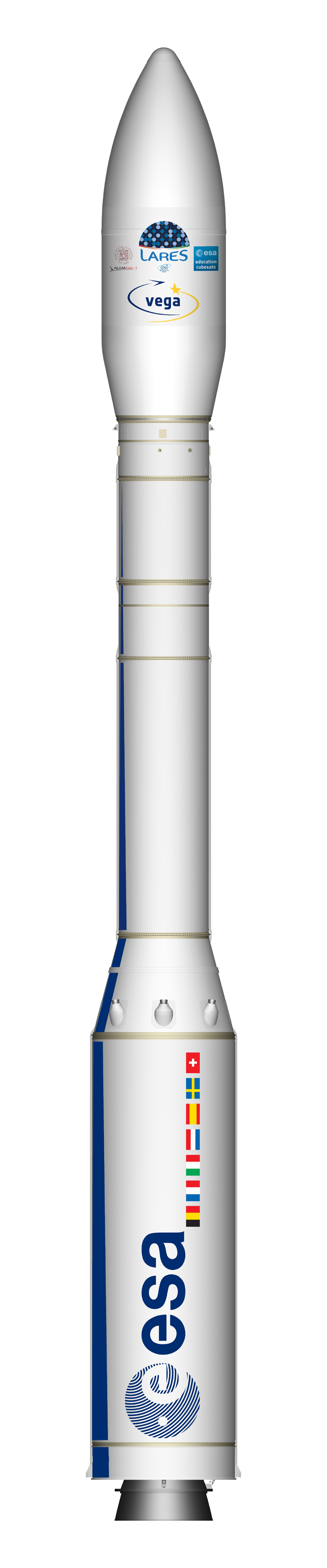
Vega |
ESA |
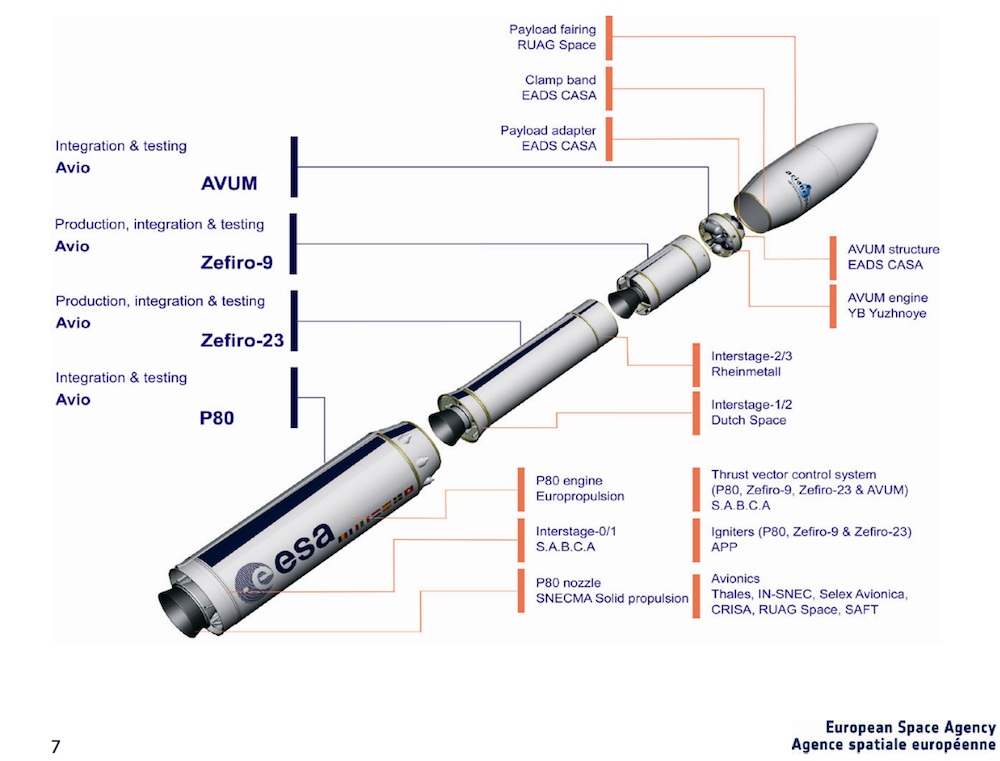
The P80FW stage:The first stage of Vega is based on a large monolithic motor with a load of 88 365 kg of HTPB solid propellant. The motor delivers 2261 kN of thrust at sea level and burns for 114.3 seconds before being jettisoned at an altitude of 61 km.
The stage features two major new technologies in order to reduce the vehicle’s mass:Both technologies will be demonstrated and qualified on Vega in preparation for future launcher developments within ESA’s Next-Generation Launcher (NGL) initiative.
- A carbon-epoxy filament-wound motor casing, the largest in the world for a monolithic motor;
- Electromechanical actuators for thrust vectoring, a world’s first for a motor of this size.
The P80FW shares a 3 m diameter with Ariane 5’s EAP solid boosters; its 11.2 m overall length is similar to one of EAP’s largest segments. The same Ariane 5 facilities and equipment at the Guiana Propellant Plant, next to the spaceport, are used for the P80FW propellant loading and transport. The stage’s nozzle is also an evolution from that of the Ariane 5 boosters.
Main features:
- motor length: 11.7m
- diameter: 3m
- propellant mass: 88 t
- motor dry mass: 7 330 kg
- motor case mass: 3 260 kg
- average thrust: 2 200 kN
- specific impulse: 280 sec
- combustion time: 110 sec
The Zefiro stages:Vega’s second and third stages are based on Zefiro solid-propellant motors developed by Avio from its earlier Zefiro-Z16 ground-qualified motor. Both motors are 1.9 m in diameter with a carbon-epoxy filament-wound motor casing, low-density EPDM insulation and a flexible joint nozzle with electromechanical actuators for thrust vector control.
The 8.39 m-long Zefiro-Z23 is loaded with 23 906 kg of HTPB 1912 solid propellant and delivers 1196 kN of thrust at sea level. It burns for 86.7 seconds.
The 4.12 m-long Zefiro-Z9A is loaded with 10 115 kg of HTPB 1912 solid propellant and delivers a maximum thrust of 313 kN in vacuum. Although it is Vega’s smallest solid-propellant motor, it has the longest burn time: 128.6 seconds. The Zefiro-Z9A also features the highest mass fraction for solid motors in this category.
The Zefiro stages are produced by Avio in its facilities in Colleferro, near Rome, Italy. They are loaded with solid propellant before their shipment to the spaceport.
Zefiro-Z23 main features:
- motor length: 7.5 m
- diameter: 1.9 m
- propellant mass: 24 t
- motor dry mass: 1 950 kg
- motor case mass: 900 kg
- average thrust: 871 kN
- ppecific impulse: 287.5 sec
- combustion time: 77 sec
Zefiro-Z9 main features:
- motor length: 3.5 m
- diameter: 1.9 m
- propellant mass: 10.5 t
- motor dry mass: 915 kg
- motor case mass: 400 kg
- average thrust: 260 kN
- pecific impulse: 296 sec
- combustion time: 120 s
AVUM:The AVUM (Attitude Vernier Upper Module) stage is composed of two different sections, one housing the propulsion elements (APM: AVUM Propulsion Module) and one dedicated to the avionics equipment housing platform (AAM: AVUM Avionics Module).
The Attitude and Vernier Upper Module has a bipropellant propulsion system for orbital injection, and a monopropellant propulsion system for controlling the vehicle’s roll and the attitude.
The APM provides for the attitude control functions and axial thrust of the Vega launcher during the final phases of flight, in accordance with the requisites of the mission.
AVUM’s primary mission begins at the end of the solid-propulsion phase, when it starts manoeuvring to reach the targeted deployment orbit with high accuracy. AVUM is designed to deliver different payloads into different orbits and to perform fine satellite pointing before separation. At the end of the mission, it is disposed of safely to limit orbital debris.
AVUM carries 550 kg of propellant (UDMH/NTO) in four tanks and is powered by a restartable 2.45 kN RD-869 engine. The total propellant load is 250-400 kg, depending on the definition of the configuration and mission to be carried out. It incorporates two clusters of three monopropellant thrusters for roll and attitude control, and accommodates the Vega avionics module, which provides flight control and mission management, telemetry, flight termination, power supply and distribution.
The current basic configuration includes the adoption of a bi-liquid propellant for primary manoeuvres, which uses Tetroxide Nitrogen (NTO) as oxidant and asymmetric monomethyl-hydrazine (UDMH) as a propellant, both fuelled by pressured helium gas, and a cold nitrogen gas system (GN2) for attitude control.
The AMM avionics module houses the main components of the avionics sub-system of the launch vehicle.
Features of AVUM:
- motor length: 1.7 m
- diameter: 2.31 m
- propellant mass: 0.55 t
- motor dry mass: 131 kg
- motor case mass: 16 kg
- average thrust: 2.42 kN
- specific impulse: 315.5 sec
- combustion time: 6.672 s
| Total Nr | Type Nr | Launch Vehicle | Serial Nr | Launch Date | L.Time | L. Site | ID Year | Payload | Comment |
| 1 | Vega | VV01 | 13/02/2012 | 10:00 | Ko, ELV | 2012-006 | LARES | ||
| 2 | Vega | VV02 | 7/05/2013 | 02:06:31 | Ko, ELV | 2013-021 | PROBA V | ||
| 3 | Vega | 30/04/2014 | 01:35:15 | Ko, ELV | 2014-024 | KazEOSat 1 | |||
| 4 | Vega | VV04 | 11/02/2015 | 13:40 | Ko, ELV | 2015-U01 | IXV | Suborbital flight | |
| 5 | 5 | Vega | VV05 | 23/06/2015 | 01:51:58 | Ko, ELV | 2015-028 | Sentinel 2A | |
| 6 | Vega | 3/12/2015 | 04:04 | Ko, ELV | 2015-070 | LISA-Pathfinder | |||
| 7 | Vega | 16/09/2016 | 01:43 | Ko, ELV | 2016-058 | PeruSat 1 | |||
| 8 | Vega | 5/12/2016 | 13:51 | CSG/ZLV | 2016-073 | Gokturk-1 | |||
| 9 | Vega | VV09 | 7/03/2017 | 01:49 | CSG, ZLV | 2017-013 | Sentinel 2B | ||
| 10 | Vega | VV10 | 2/08/2017 | 01:58 | Ko, ELV | 2017-044 | OPTSAT-3000 | ||
| 11 | Vega | 8/11/2017 | 01:42 | Ko, ELV | 2017-070 | Mohammed VI A (MN35-13) | |||
| 12 | Vega | VV12 | 22/08/2018 | 21:20 | CSG, ELV | 2018-066 | Aeolus (Earth Expl 4) | ||
| 13 | Vega | VV13 | 21/11/2018 | 01:42 | CSG, ELV | 2018-095 | Mohammed VI-B | ||
| 14 | Vega | 22/03/2019 | 01:50 | CSG, ELV | 2019-015 | PRISMA | |||
| 15 | Vega | VV15 | 11/07/2019 | 01:53 | CSG, ELV | 2019-F05 | Falcon Eye 1 | ||
| 16 | Vega | VV16 | 3/09/2020 | 01:51:10 | Ko, ELV | 2020-061 | NuSat 6 | ||
| 17 | Vega | VV17 | 17/11/2020 | 01:52:20 | Ko, ELV | 2020-F09 | SEOSAT-Ingenio | ||
| 18 | Vega | VV18 | 29/04/2021 | 01:50 | Ko, ELV | 2021-034 | Pl?iades-Neo 3 | ||
| 19 | Vega | VV19 | 17/08/2021 | 01:47:06 | Ko, ELV | 2021-073 | Pl?iades-Neo 4HR-2020 2) | ||
| 20 | Vega | VV20 | 16/11/2021 | 09:27:55 | Ko, ELV | 2021-105 | CERES 1/3 | ||
| 21 | Vega | VV23 | 9/10/2023 | 01:36 | Ko, ELV | 2023-155 | THEOS 2 (T2V) | ||
| 22 | Vega | VV24 | 5/09/2024 | 01:50 | Ko, ELV | 2024-157 | Sentinel 2C |
| Ref.: #110, #205a - update: 02.04.17 | Home |