Artemis

ESA

Spacecraft nº:

ESA spacecraft nº: 47

Advanced Data Relay and Technology Mission Satellite

Launch data:

Designation 26863 / 01029A
Launch date 12 Jul 2001 - 21:58 UT
Launch site Ko, ELA-3
Launch vehicle Ariane-5G (V142 / #510)
Mission Commercial: Communications
Government: Research
Geostationary orbit on:
Perigee / Apogee 35771 x 35803 km
Eccentricity 3.80E-04
Inclination 7.03 deg
Period 1436.12 min
Location should reach 21.5°E before end of 2002


Launched failed to deliver the satellite in GTO. It will slowly be upped to GEO with its conventional motors (by mid-2002). First the orbit was raised into a circular 31000 km orbit, and in Feb 2002 the final push was made with the ion engines (200 days are needed, orbit raised by 1 km per hour!).

The satellite was developed by a consortium headed by the Italian company Alenia Aerospazio. Italy has a 40 percent share, France 21.25 percent, Germany 12 percent, Spain 7.5 percent, Britain 6.7 percent and Belgium four percent. The satellite is worth approx. EUR 820 million. ESA's most expensive satellite.

Artemis will also provide data relay links at Ka-Band (23 to 27 GHz) and S-Band (2 GHz). It will also carry an advanced L-Band (1,61 GHz) payload providing communications to mobile users. Some L-band capacity will be used to send EGNOS signals (see Galileo). Artemis will be used as relay by Spot 4, Envisat 1, Oicets, etc.

A navigation terminal to guide civilian aircraft, boats and land vehicles will be placed onboard. This modification will cost $8 million.

Specifications

Prime contractor Alenia Spazio / Italy
Platform  
Operator European Space Agency
Mass at launch 3105 kg
Dry mass 1500 kg
Dimension  
Solar array  
Stabilization 3-axis
DC power 4600 W
Design lifetime 10 years

Location:

DatePositionRemarks
 Apr 2009  21.36° E 

Has got liquid-propellant motors (1 of 410 N and 16 of 10 N thrust) and ion propulsion (15 mN and 18 mN). Tanks contain 1538 kg ergols and 40 kg Xenon.

Four beams will cover Europe, North Africa, and Near East and will be able to handle up to 400 bi-directionnal links.


SKDR (S/Ka band Data Relay)

Main transponders Ka band (20/ 30 GHz)
S band (2 GHz) and Ka band (23/26 GHz)
Backup transponders  
Power  
Bandwidth  
Coverage  
EIRP max  
G/T max  
Polarization  
Frequencies 20/30 GHz
23-26 GHz (interorbit)
2 GHz (interorbit)

The antenna is 2.85 m diameter, aimed at Envisat 1

SILEX (Semi-conductor Inter-satellite Link Experiment) uses optical frequencies; it will work with Spot 4 and Oicets. It was successfully tested in Nov 2001 at 50 Mbps.

LLM

Main transponders L-band (1.5/1.6 GHz):
Ku-band (12/14 GHz):
Power  
Bandwidth L-band: 4 MHz?
Ku-band: 0.9 MHz?
Coverage Europe
EIRP max  

LLM will be leased to Eutelsat.

A navigation payload (25 kg) was also added. It is part of the EGNOS program (European Geostationnary Navigation Overlay Service). Two Inmarsat 3 satellites are also part of this program.

An 18-month rescue mission recovered the satellite; develop European capabilities in satellite communications; test new technologies; support development of European navigation system (EGNOS, c. 2010).

Astrophilately covers:

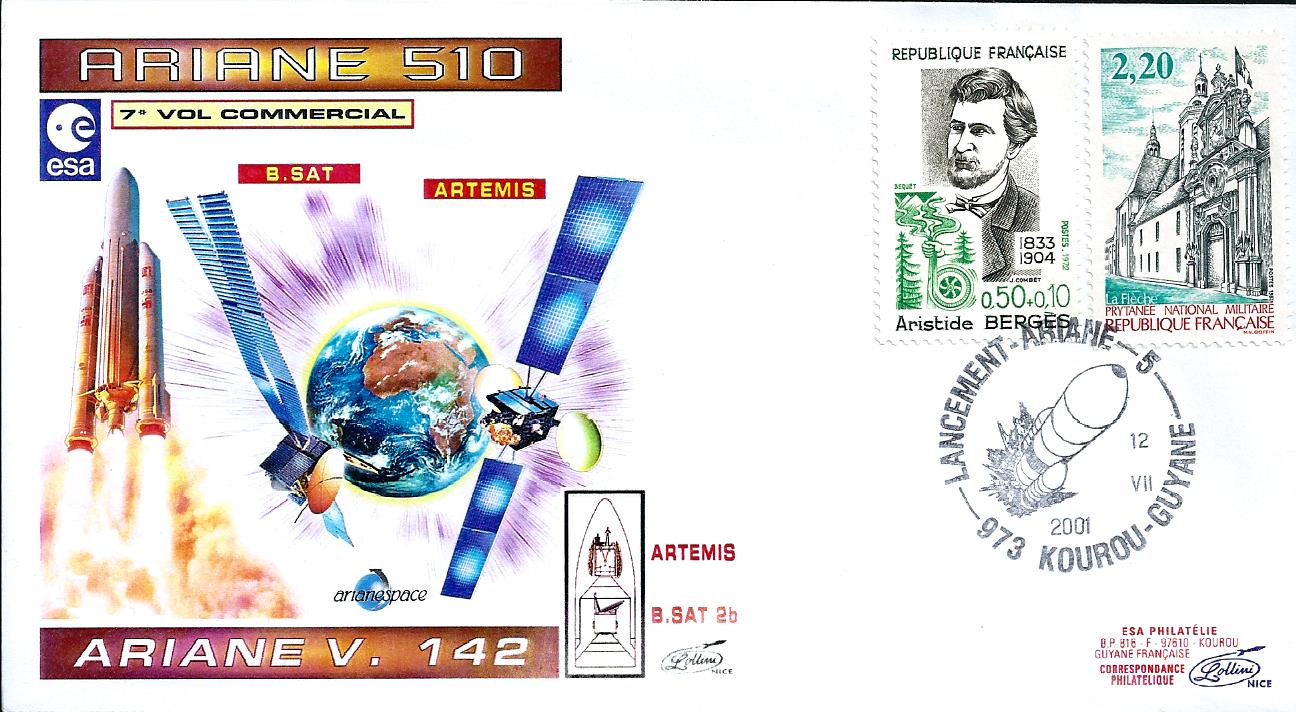
Ariane-510

Launch cancel Kourou. Credit covers: J.VdDr.

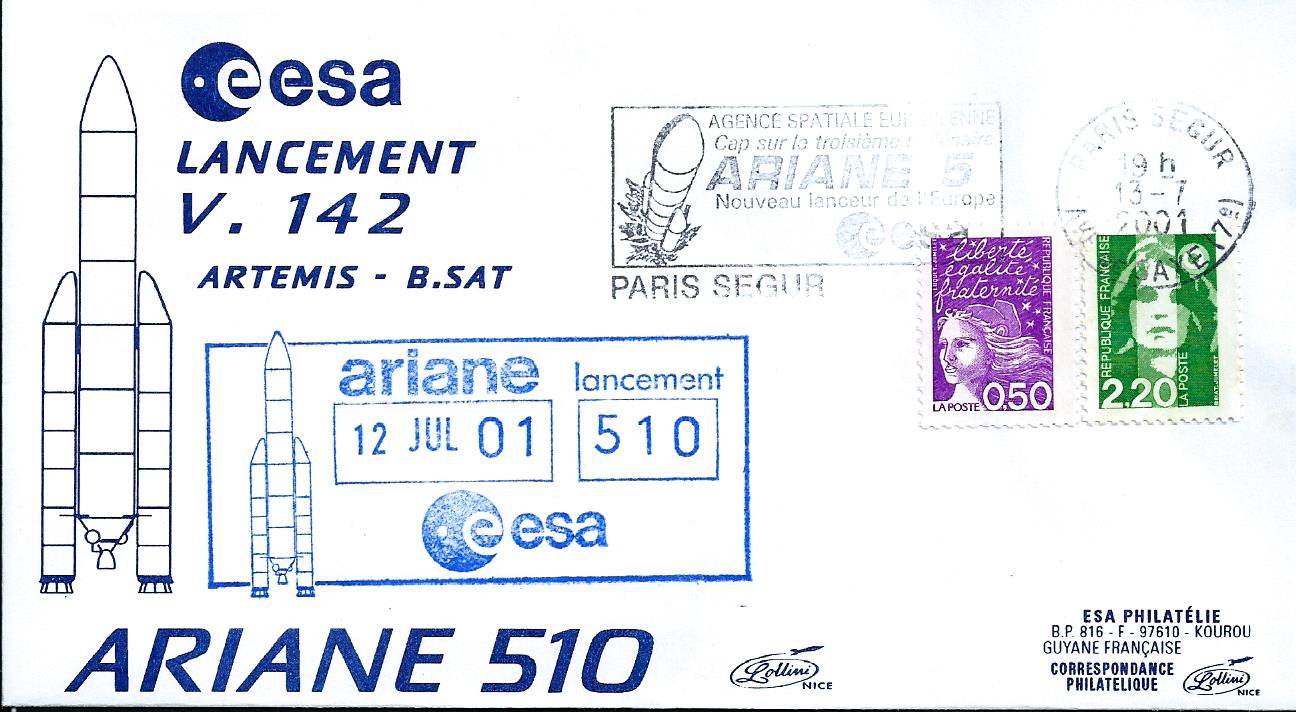
Ariane-510

Headquarter cancel Paris


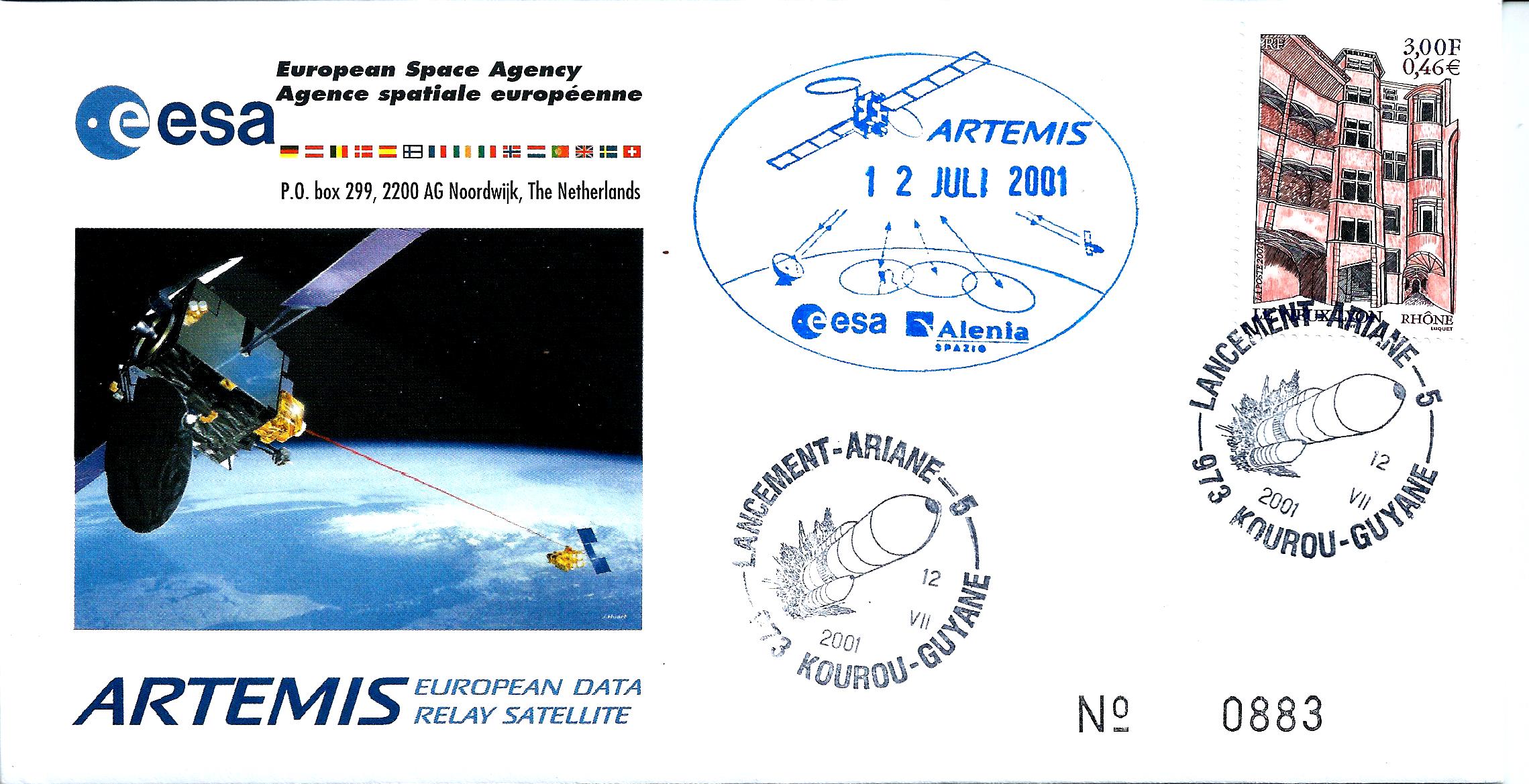
Ariane-510

Launch cancel Kourou. ESA cover, numbering


Ref.: #7, #15, #78a, #226, #415 - update: 16.07.21 Home