 -
-
A4/V2 Design & Tech Data |
Germany |
| -
| |
 and the horizontal vanes and rudders 2 and 4, in this manner. - Vanes and rudders
1 and 3 (react together) control the oscillation and heading in the lateral
movement, then the movement in the projectiles along a given axis, which
stands perpendicular on the vertical movement by the same along the axis.
Rudders 2 and 4 control the oscillation and heading in the vertical movement
in the same manner on their axis. Vanes 2 and 4 controls roll stabilization.
Vanes 1, 2, 3, and 4 are controlled by a gyroscope. They keep the axis
of the V2 vertical. Rudders 2 and 4 are controlled by another gyroscope.
They take care of the angle (as from the vertical) of the rocket during
burn time. The latter gyroscope is controlled by a third gyroscope that
makes sure the first mile will be straight up, after that it is turning
until the correct elevation is reached, This elevation is kept until the
speed is high enough to reach the target, finally the last gyroscope shuts
off fuel supply. After shutdown the rocket acts as a regular artillery
shell.
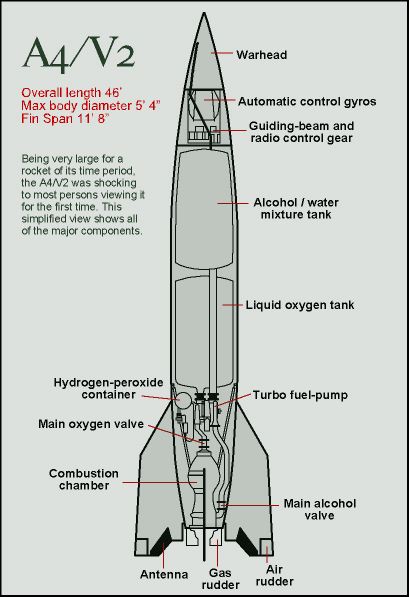
Fully fueled, the V2 had 4900 kg A-Stoff which was liquid oxygen with a temperature
of minus 183 degrees Celsius, and 3710 kg of a mixture of 75% Ethyl alcohol
and 25% water, called B-Stoff. The oxygen evaporated so quickly that the
tank truck started at the load station with 6400 kg, so when they arrived
at the site for V2 fueling, 1500 kg was already evaporated. The rocket
also carried 175 kg of T-Stoff, which was 80% hydrogen, and 22 kg Z-Stoff
which was a mixture of 1/3 part sodium permanganate and 2/3 part water.
The latter was for propulsion of the 580 horsepower turbine, compressed
air pushed those materials with a pressure of 32 bar in this turbine, 385
degrees Celsius vapor brought the turbine to 3800 RPM. Each second, 58
kg alcohol of 23 bars had to be pressed via 1224 injection ports, and 72
kg oxygen with a pressure of 17.5 bars via 2160 injection ports into the
burning chamber, that eventually at a pressure of 15 bars brought the temperature
to 2500 degrees Celsius. Initial lift pressure was 3 tons, which took 3
seconds (for observation of good ignition) and than raised to 25 tons.
and the horizontal vanes and rudders 2 and 4, in this manner. - Vanes and rudders
1 and 3 (react together) control the oscillation and heading in the lateral
movement, then the movement in the projectiles along a given axis, which
stands perpendicular on the vertical movement by the same along the axis.
Rudders 2 and 4 control the oscillation and heading in the vertical movement
in the same manner on their axis. Vanes 2 and 4 controls roll stabilization.
Vanes 1, 2, 3, and 4 are controlled by a gyroscope. They keep the axis
of the V2 vertical. Rudders 2 and 4 are controlled by another gyroscope.
They take care of the angle (as from the vertical) of the rocket during
burn time. The latter gyroscope is controlled by a third gyroscope that
makes sure the first mile will be straight up, after that it is turning
until the correct elevation is reached, This elevation is kept until the
speed is high enough to reach the target, finally the last gyroscope shuts
off fuel supply. After shutdown the rocket acts as a regular artillery
shell.
Fully fueled, the V2 had 4900 kg A-Stoff which was liquid oxygen with a temperature
of minus 183 degrees Celsius, and 3710 kg of a mixture of 75% Ethyl alcohol
and 25% water, called B-Stoff. The oxygen evaporated so quickly that the
tank truck started at the load station with 6400 kg, so when they arrived
at the site for V2 fueling, 1500 kg was already evaporated. The rocket
also carried 175 kg of T-Stoff, which was 80% hydrogen, and 22 kg Z-Stoff
which was a mixture of 1/3 part sodium permanganate and 2/3 part water.
The latter was for propulsion of the 580 horsepower turbine, compressed
air pushed those materials with a pressure of 32 bar in this turbine, 385
degrees Celsius vapor brought the turbine to 3800 RPM. Each second, 58
kg alcohol of 23 bars had to be pressed via 1224 injection ports, and 72
kg oxygen with a pressure of 17.5 bars via 2160 injection ports into the
burning chamber, that eventually at a pressure of 15 bars brought the temperature
to 2500 degrees Celsius. Initial lift pressure was 3 tons, which took 3
seconds (for observation of good ignition) and than raised to 25 tons.
 |
Power: Liquid-fuelled rocket motor (Lox/Alcohol)
|
 |
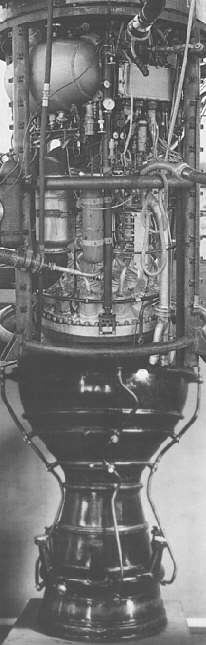 |
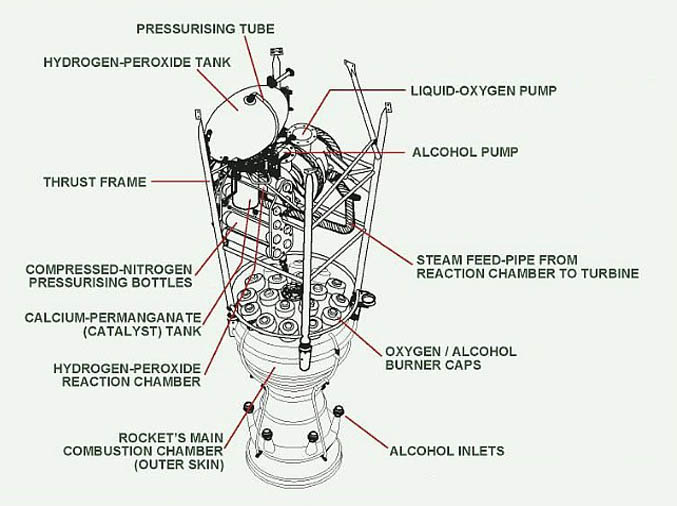
The A4 rocket motor was the first design that successfully moved large volumes of fuel to the combustion chamber using gas-turbine driven fuel pumps. The gas-turbine was powered by hydrogen peroxide, of which 130 litres were contained in the small ellipsoidal tank. This liquid was expelled from the tank by compressed nitrogen from the bottles on the rack. The thrust frame was one of the key components in the engine assembly. The frame was able to successfully transmit 25-tons thrust to the rocket and withstood the punishment while being extremely light as well- (Drawing based on original in Peenemünde archives)
| Ref.: #http://www.v2rocket.com - update: 09.03.2026 | Home |