ATDA= Augmented Target Docking Adapter
Target for Gemini 9A
Launch, orbit & landing data:
| Designation | 02186 / 66046A |
| Launch date - time | 01 Jun 1966 - 15:00:02 UT |
| Launch site | CC, LC14 |
| Launch vehicle |
Atlas SLV-3 (#5304) |
| Earth orbit on Jun 2.4: |
| - Perigee / Apogee | 292 x 296 km |
| - Eccentricity | 0.0003 |
| - Inclination | 28.87° |
| - Period | 90.24 min |
Spacecraft data:
| Prime contractor | |
| Customer | NASA |
| Mass at launch | 771 kg (794 kg?) |
| Dry Mass | kg |
| Basic shape | cylinder |
| Dimensions | 3.7 long - 1.52 dia |
|
Decay:
| Descent date: | 11 Jul 1966 - 15:50 UT |
| Lifetime: | 40.03 days |
|
Mission details:
As contractors worried about technical problems, NASA again faced the necessity for a quick recovery plan
when a target vehicle failed to reach orbit. This time, however, the agency had something in the hangar, an
alternate vehicle - the ATDA. After the Agena exploded in October 1965, NASA had ordered General
Dynamics/Convair to be prepared to furnish a backup Atlas within 14 days of another such catastrophe. And in
April 1966, just a month before the attempted launch of Gemini IX, Schneider had reminded Preston that he
would have to be ready to launch the alternate target in a hurry if the Agena again failed to keep its
orbital appointment. Now it had. On 18 May, Mathews wired Colonel John Hudson, Deputy Commander for Launch
Vehicles, Air Force Space Systems Division, to prepare Atlas 5304 for launch on 31 May in a mission now
called Gemini IX-A.
With what had been the backup plan now in effect, the next question was what to do if the ATDA, too, failed.
At a staff meeting on 18 May, Mathews announced that Gemini IX-A would be launched anyway, to rendezvous
with the Gemini VIII Agena, still in orbit. McDonnell, in any case, was confident of the ATDA. When Mathews
asked, in a management meeting in St. Louis the next day, "Does anyone have any reservations about flying
the ATDA?" the answer was no. That was just as well, because the motion of a rendezvous with the old Agena
soon had to be abandoned. Its orbit had not decayed to the expected extent, and it was still sailing around
Earth 402 kilometers up. Without the help of Agena, high- altitude flight might take too much spacecraft
fuel and leave the crew stranded with no way to get to the lower orbit needed for retrofire. Deputy
Administrator Robert Seamans and Mueller agreed with Mathews that rendezvous with Agena 8 was too risky,
but Gemini IX-A would still fly, even if the substitute target did not make it. Extravehicular activity
with the AMU was a much needed venture in its own right.
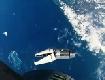 |
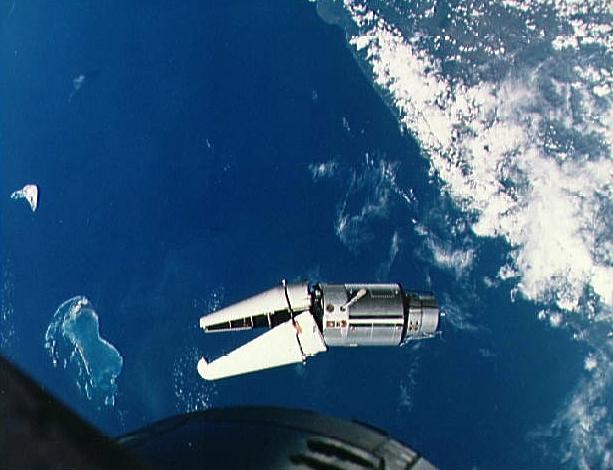
Gemini 9 - Augmented Target Docking Adapter as seen from the
Gemini 9 spacecraft - Credit: NASA. |
Long before these decisions were made, the Atlas contractors were frantically busy. Keehn had bundled up
the telemetry tapes and headed for San Diego, where study of the data plus some tests located the trouble
in the electrical wiring. Within a week, Keehn and his group pinpointed the cause of the failure: a
pinched wire in the autopilot that produced a short circuit. This meant some extra work on the electrical
connectors, and General Dynamics asked NASA for an extra day to complete the task and prepare Atlas 5304
for launch. The agency set 1 June as the new date.
On 1 June 1966, men and machines were again gathered at the Cape Kennedy launch site, this time to try to
send the alternate target vehicle and Gemini IX-A into coordinated orbital flight. At the appointed time,
10:00 a.m., the Atlas rose from pad 14. After a six-minute boosted phase, it tossed the ATDA into a nearly
perfect 298-kilometer orbit. Just one thing marred the picture: telemetry signals suggested that the
launch shroud covering the docking port had only partially opened and had failed to jettison.
 |
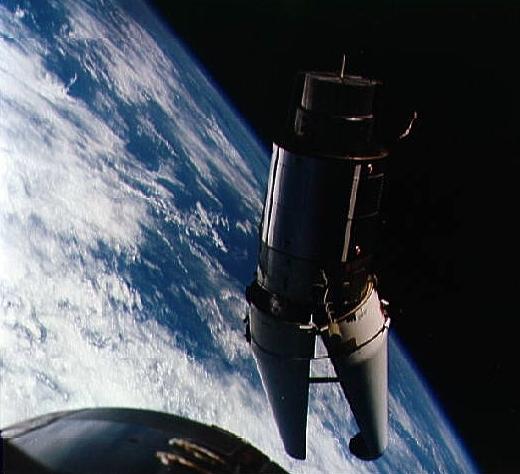
Augmented Target Docking Adapter as seen from the
Gemini 9 spacecraft - Credit: NASA. |
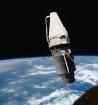 |
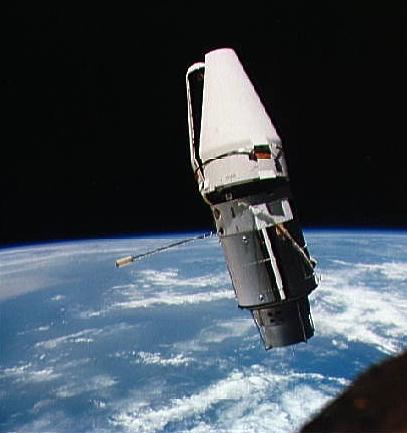
Augmented Target Docking Adapter as seen from the
Gemini 9 spacecraft - Credit: NASA. |
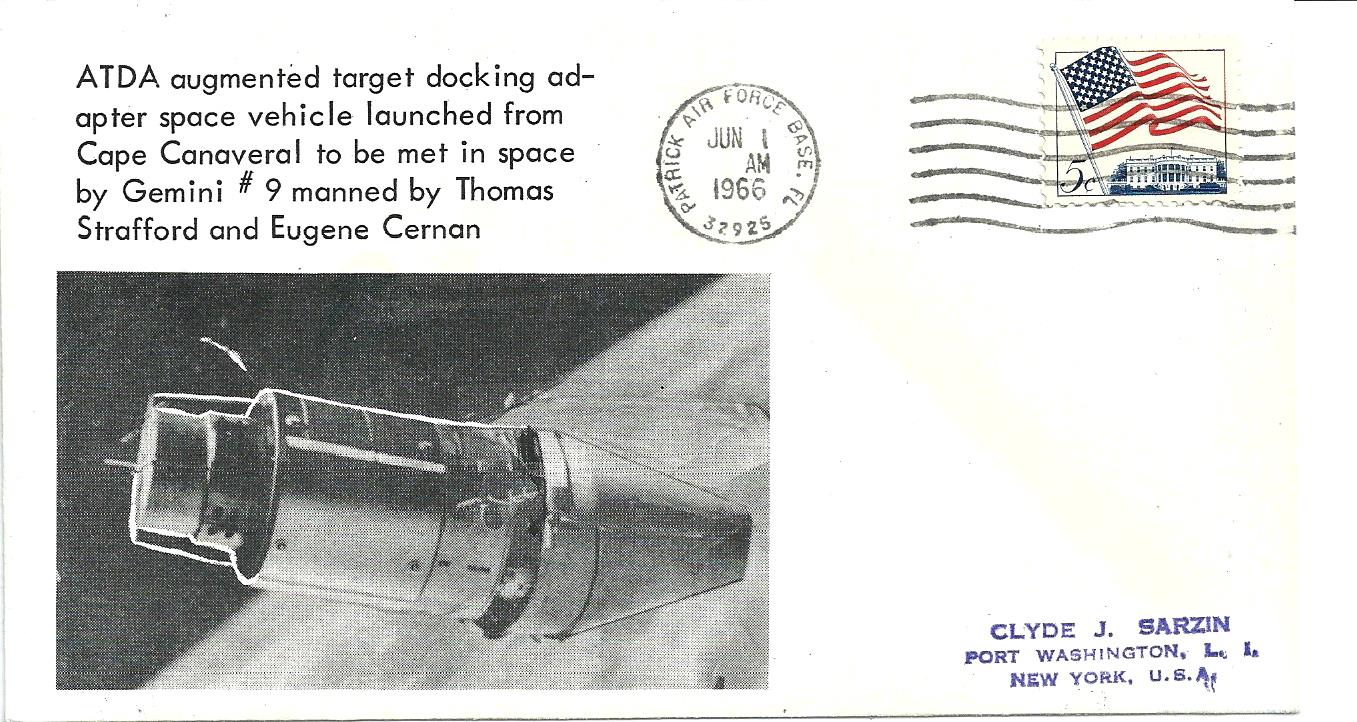
Astrophilately covers: