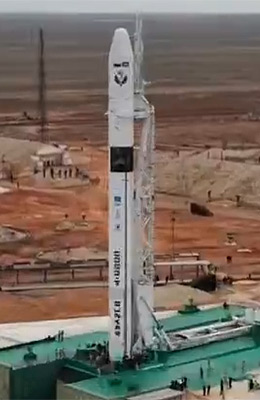
Soyuz-5

Russia


Technical Data:

Developer / Manufacturer RKTs Progress
CountryRussia
Overall Length (m) Uncrewed: 61.9 m
Crewed: 65.9 m
Diameter (m) 4.1 m
Lift-off Mass (t) 530 t
Stages3
Payload to LEO (kg) Uncrewed: 18,000 kg
Crewed: 15,500 kg
Payload to GTO (kg) 5,000 kg
Stage First Stage Second Stage Third Stage - Blok DM-SLB (optional)
Height 37.14 m 7.77 m 6.28 m
Diameter 4.1 m 4.1 m 3.7 m
Empty mass 27,700 kg 5,900 kg -
Propellant mass 363,000 kg 59,000 kg 18,700 kg
Powered by 1 x RD-171 MV 1 x RD-0124MS 1 x RD-58MF
Max Thrust (KN) 7,257 kN 588.6 kN 49.03 kN
Engine Specific Impulse (N·Sec/kg) 309 s 359 s 353 s
Burn time (sec) 179 s 393 s -
Propellant LOX / RP-1 LOX / RP-1 LOX / RP-1

Description:

Vehicle description:

  • Soyuz-5, as proposed in 2016, leverages existing propulsion and tooling, while enabling a platform that would replace the lost capabilities of the Zenit family, replace the Proton Light/Medium, and could serve as the boosters of a new super heavy rocket. It will initially be a two-stage rocket, but could be enhanced with an optional Blok DM-03 for geostationary missions. It would be compatible with most of the Zenit's ground infrastructure, and even use the Site 45 at Baikonur.
  • Its tanks would be 4.1 m (13 ft) in diameter, which would enable the re use of Proton tooling. Since they would be wider than Zenit, (3.9 m (13 ft)) it would enable a higher propellant load for the same height. While this diameter enables a heavier rocket and is already compatible with train transport to Baikonur, it would prevent that method of transport for Vostochny Cosmodrome. It would use the relatively environmental friendly RP-1/LOX propellant, which would be an improvement over the highly toxic hypergolics of Proton. This has been a requirement from the Kazakhstani government for new projects.
  • The first stage will be powered by an RD-171MV, very similar to the RD-171M used in Zenit 2 and 3. With a height of 37.14 m (121.9 ft) it would be higher than Zenit's first stage (32.94 m (108.1 ft)) and wider, and thus it could carry 363 t (400 tons) of propellant versus 290 t (320 tons). Its base would still feature a 3.68 m (12.1 ft) aft section for compatibility with Zenit's pad and support infrastructure.
  • Its second stage would measure 7.77 m (25.5 ft) by 4.1 m (13 ft) in diameter, with a dry mass of 5.9 t (6.5 tons) and an RG-1/LOX load of 59 t (65 tons). It will be powered by a RD-0124MS engine.
  • With a gross mass of 484 t (534 tons) against Zenit 430 t (470 tons), and the improved efficiency of its second stage, it could launch 16 t (18 tons) to a 200 km circular orbit with an inclination of 51.6° to the Equator from Baikonur. This is a significant improvement over Zenit, which could only place roughly 12 t (13 tons) to the same orbit.
  • For geostationary launch missions, it could optionally be equipped with a Blok DM-03 third stage. Since it would use the same propellant and is already used on the Zenit-3SL and Angara A5, it would be a low risk option. The expected performance of 4.5 t (5.0 tons) to GTO and 2.3 t (2.5 tons) to GSO, it would improve over Zenit-3SLB 3.6 t (4.0 tons) and 1.59 t (1.75 tons).
  • For geostationary missions, Soyuz-5 can be equipped with the Blok DM-03 third stage. This stage, already used on vehicles such as Zenit-3SL and Angara A5, reduces development risk due to its operational heritage. With this configuration, Soyuz-5 is expected to deliver approximately 4.5 t to geostationary transfer orbit (GTO) and 2.3 t to geostationary orbit (GSO), improving on Zenit-3SLB performance.
  • The maiden flight of Soyuz-5 was on April 30, 2026 from Baikonur Cosmodrome.

    Launch List:

    Type Nr Launch Vehicle Serial Nr Launch Date L.Time L. Site ID Year Payload Comment

    Note:

    - Launches from Baikonur
    - All "Launch Date" and "L. Time" are in UTC time.

    External links:


    Ref.: #0, #16, #98 - update:04.02.2026 Home