| Nr. |
Name |
Job |
| 1/2 |
Peskov, Kirill Aleksandrovich (Russia) |
Commander |
Description:
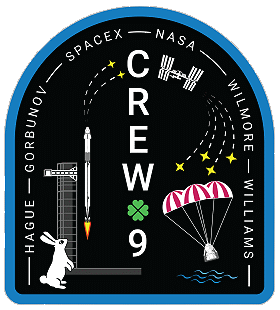
- SpaceX Crew-9 was the ninth operational NASA Commercial Crew Program flight and the 15th crewed orbital flight of a Crew Dragon spacecraft.
- Originally scheduled to carry a crew of four to the International Space Station (ISS) in mid-August 2024, the mission was delayed by more than a
month by problems with the Boeing Starliner Calypso spacecraft that was docked at the ISS for the Boeing Crew Flight Test. NASA decided to send the
Starliner back to Earth uncrewed, launch Crew-9 with two crew members, and return with four crew members, including the two crew members of the Boeing
Crew Flight Test. After that delay and other delays largely due to weather, Crew-9 launched on September 28 at 17:17:21 UTC (1:17:21 pm EDT, local time at the launch site).
- The Crew-9 mission marked several milestones. It was the first crewed mission to launch from Cape Canaveral Space Launch Complex 40; astronaut Nick Hague
was the first active U.S. Space Force Guardian to launch to space; and the mission was the last Dragon capsule to splash down in the eastern United States.
Mission details:
- ISS exp.72.
- SpaceX Crew-9 is the ninth operational NASA Commercial Crew Program flight to the International Space Station (ISS) and the 15th crewed orbital mission for a SpaceX Dragon spacecraft. The flight was originally planned to deliver four crew members to the ISS for Expedition 72, a six-month science mission: NASA astronauts Zena Cardman (commander), Nick Hague (pilot), and Stephanie Wilson (mission specialist), along with Roscosmos cosmonaut Aleksandr Gorbunov (mission specialist).[1] However, NASA decided to return the two astronauts of the Starliner crewed flight test, using Crew-9. Therefore, Crew-9 launched with a crew of two instead.[6] Hague served as commander, flying alongside Gorbunov.
- The Dragon spacecraft, named Freedom, is a veteran of the SpaceX Crew-4 and Axiom Space's Ax-2 and Ax-3 missions.[7] The Falcon 9 first-stage booster, designated B1085, made its second flight.
- Originally scheduled for August 18, 2024, the launch was rescheduled to September 24 after NASA decided to return the Boeing Starliner Calypso spacecraft of the Boeing Crew Flight Test without its crew. This delay provided NASA additional time to assess the Starliner's condition, develop a safe return plan for its crew, and reconfigure the Starliner's software for an uncrewed return.[8][9] ISS has only two IDSS ports, and one was occupied by Crew-8 while the other was occupied by Starliner. Therefore, Crew-9 did not launch until after Starliner undocked. Until Crew-9 arrived, they arranged to use SpaceX Crew-8 as their temporary emergency evacuation spacecraft, after which they transferred to Crew-9.[
- Crew-9 was slated to use Launch Complex 39A (LC-39A) at Kennedy Space Center, which had supported all previous SpaceX's crewed missions and is also the only pad that can support Falcon Heavy launches. When Crew-9's launch was rescheduled to September 24, it was brought close to the launch NASA's Europa Clipper mission, which needed to launch from LC-39A on a Falcon Heavy during a 21-day window in early October. To avoid scheduling conflicts and ensure ample preparation time for both missions, SpaceX shifted the Crew-9 launch to Space Launch Complex 40 at Cape Canaveral Space Force Station.[11] This was the first crewed mission to lift off from SLC-40. SpaceX had been constructing a crew access tower at this location since 2023 to facilitate such operations.
- Hague, a U.S. Space Force colonel, is the first active member of the Space Force to launch into space since the branch was established in 2019. Because the launch moved to SLC-40, the mission also marks the first time a Space Force service member launched from a Space Force launch complex.[13]
Crew Dragon Freedom was relocated from the forward port of the Harmony module to the zenith (space facing) port to free up the forward port for CRS-31. All four astronauts that would later be returning home on Freedom were aboard the capsule for the relocation because the spacecraft is also the crew's "lifeboat".
- The mission featured the last Dragon capsule splashdown in the Gulf of Mexico in March 2025. While SpaceX Dragon 1 missions had previously landed in the Pacific, SpaceX and NASA had shifted recovery operations to the Eastern U.S. in 2019. The move allowed astronauts and critical cargo to return to Kennedy Space Center more quickly after splashdown, and SpaceX opened a facility in Florida to take in capsules after flight and prepare them for the next mission. However, the move had an unforeseen consequence: the trunk module had to be jettisoned before reentry, and while the team expected it would burn up, SpaceX became aware of at least four cases of trunk debris being found on land. The shift back to Pacific Ocean splashdowns means that the trunk can stay attached longer and be directed towards a remote area of the ocean called Point Nemo (nicknamed the spacecraft cemetery), where any debris that survives reentry will be unlikely to cause damage.
External links:
Astrophilately covers:
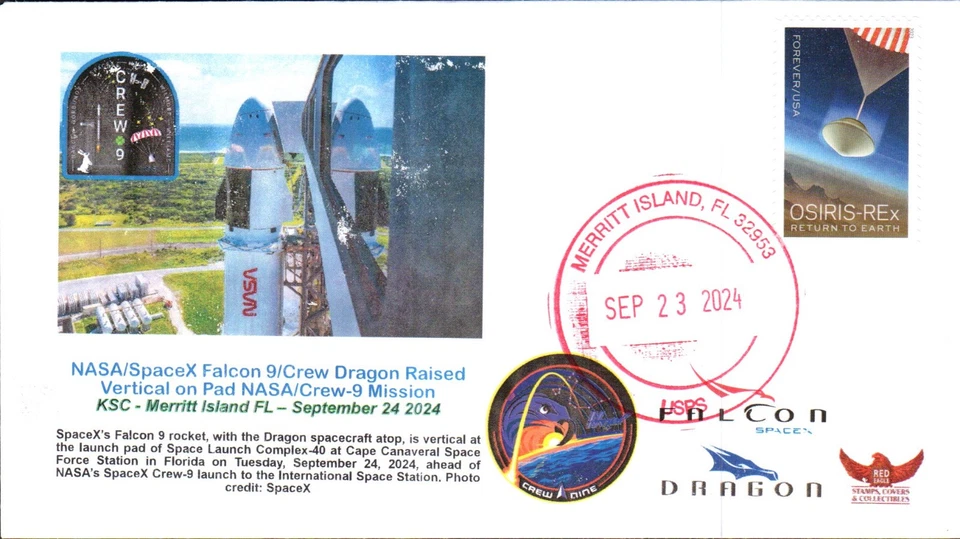 Crew 9 Falcon rocket raised vertical on pad. Credit: #411 |
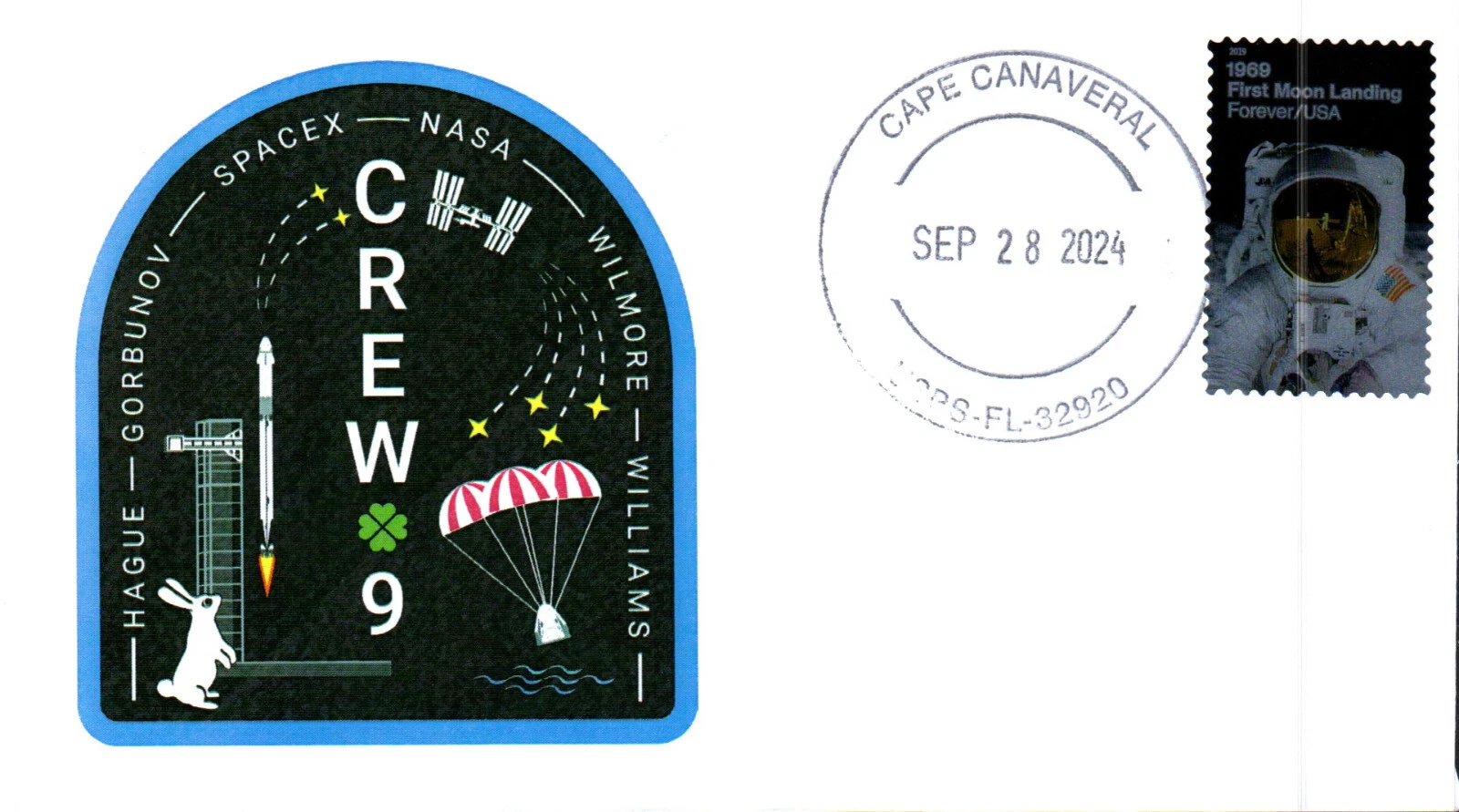 Crew 9 launch. Credit: #411 |
>
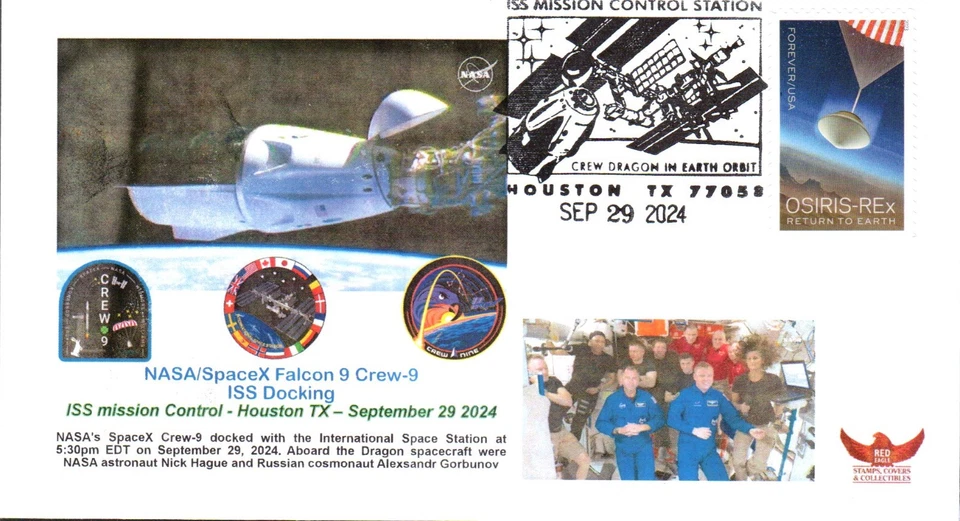 Crew 9, 1e docking. Credit: #411 |
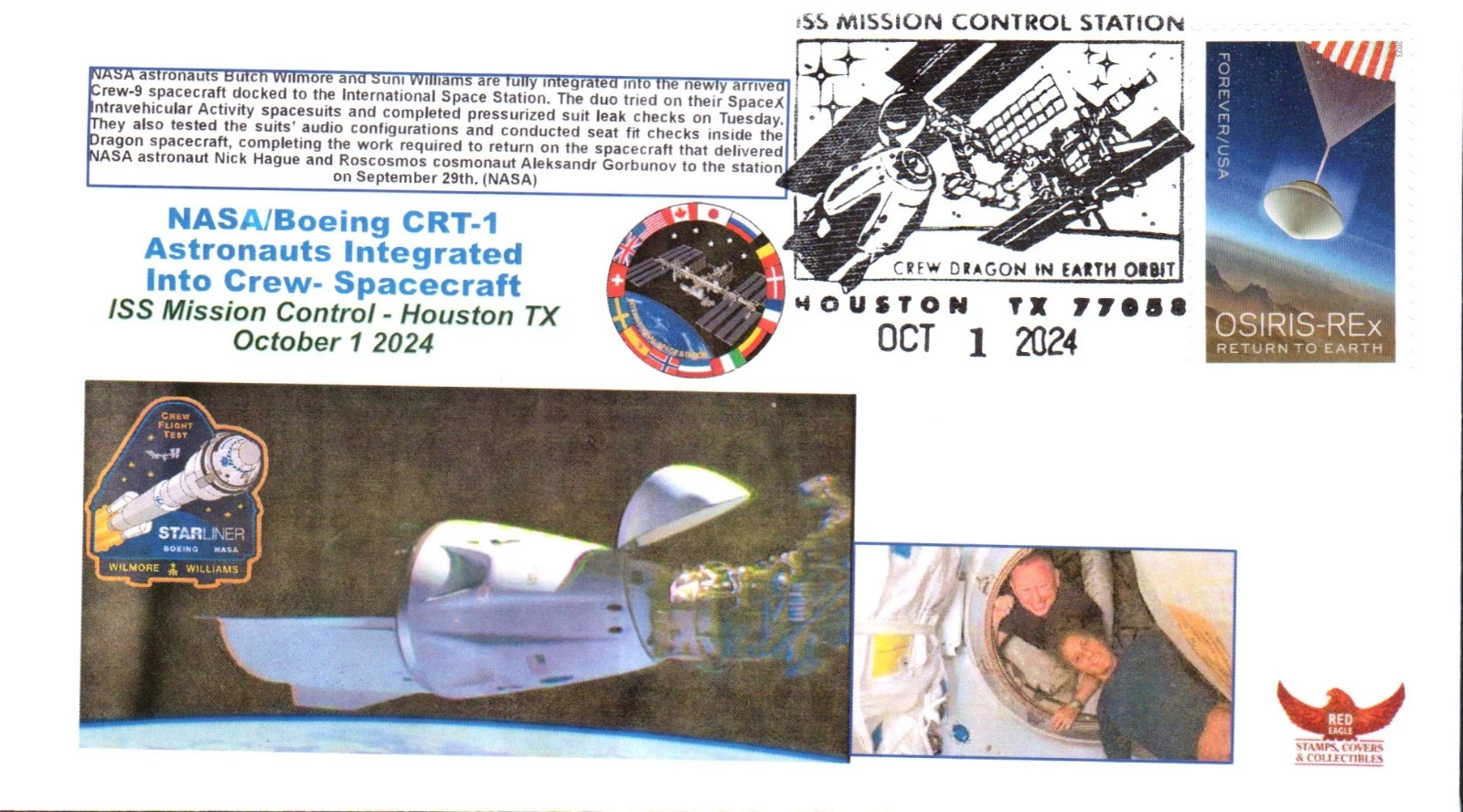 Crew 9 astronauts Integrated. Credit: #411 |
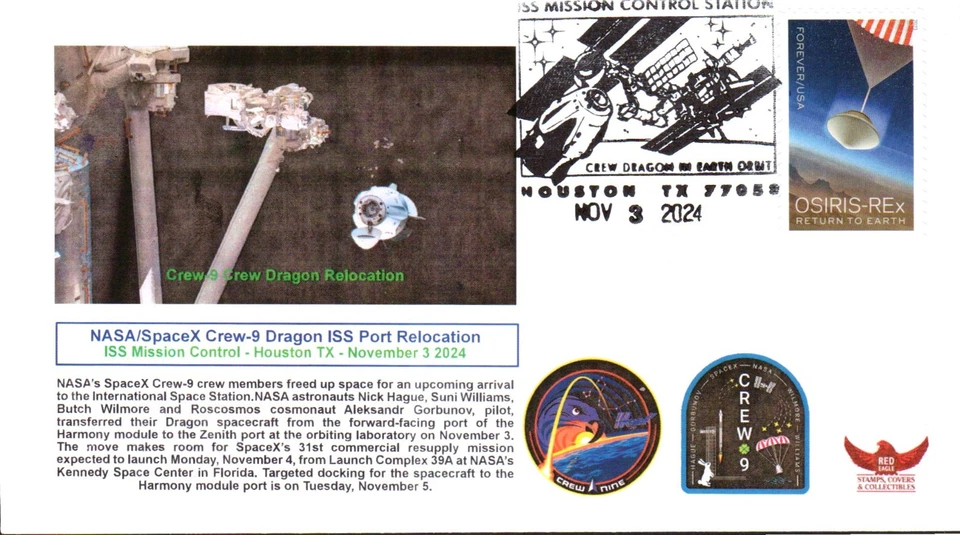 Crew 9, Redocking. Credit: #411 |
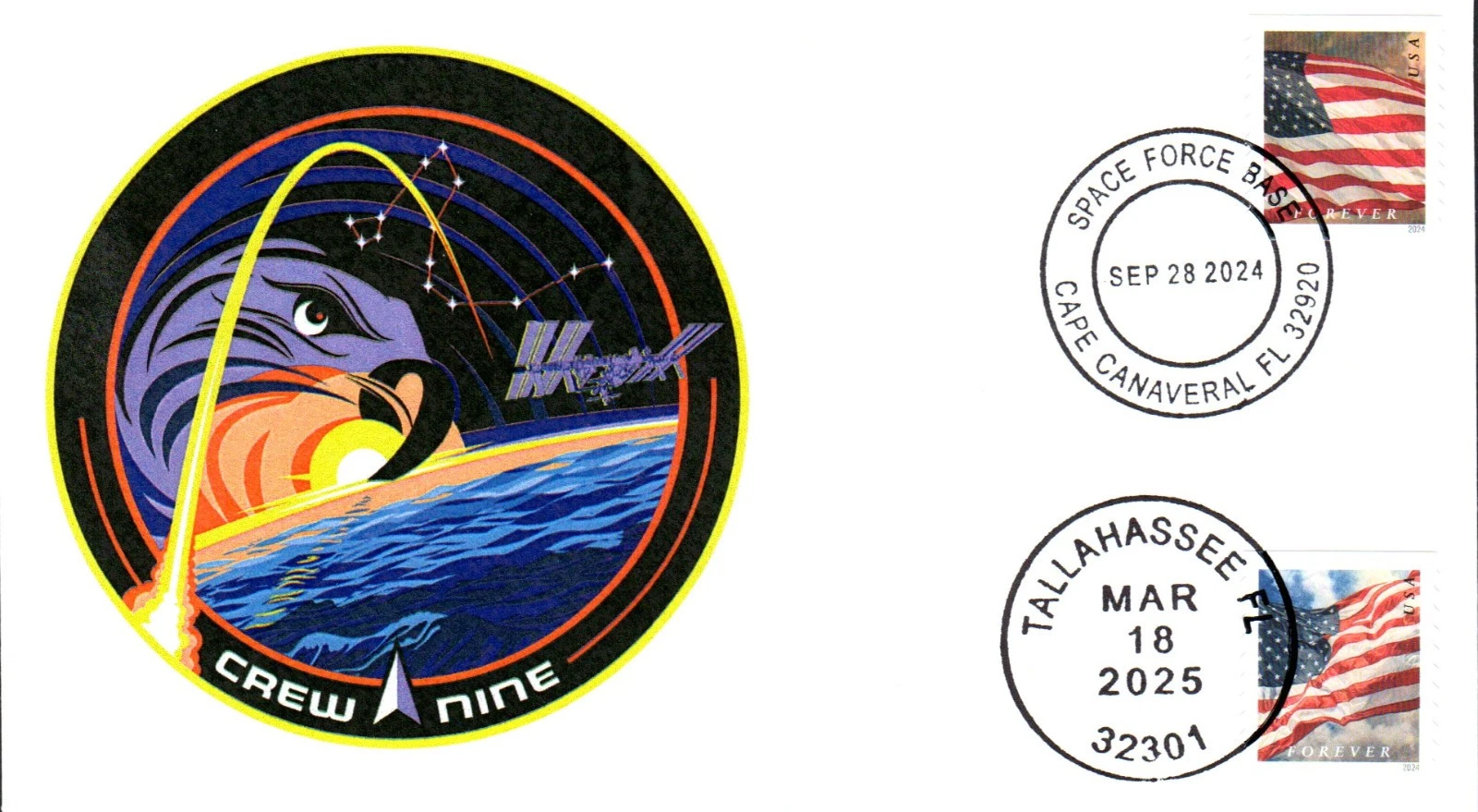 Crew 9 launch & landing cancels. Credit: #411 |
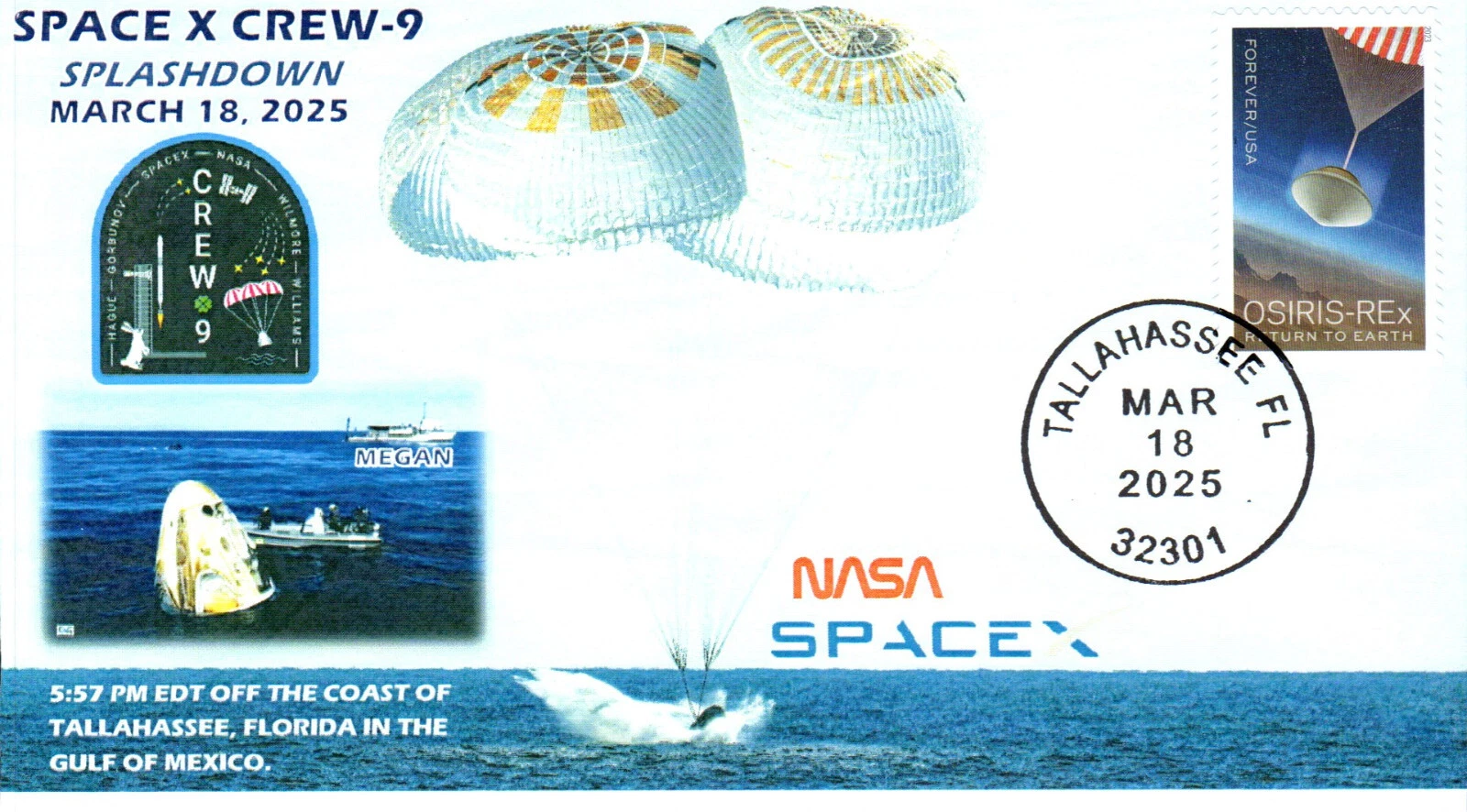 Crew 9 Splashdown. Credit: #411 |
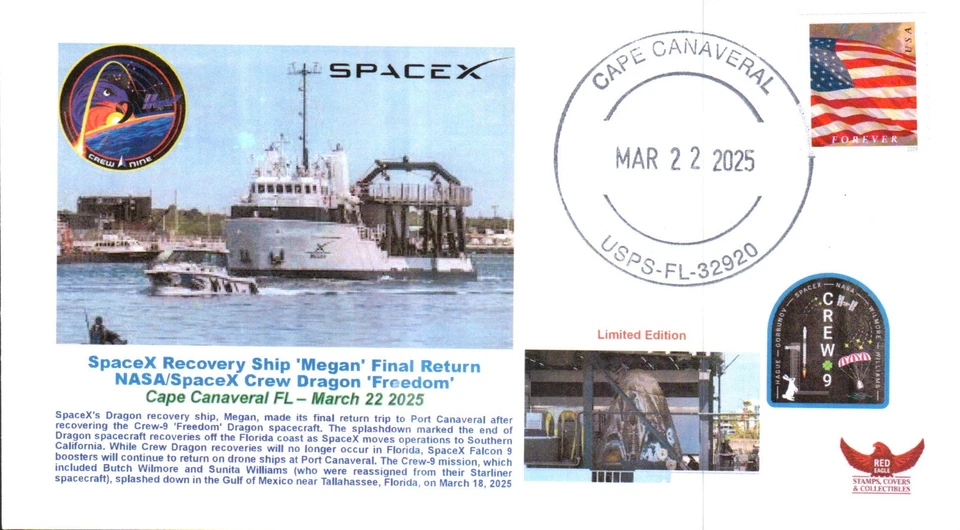 Recovery ship "Megan" Return cancel. Credit: #411 |
 Crew 9 cancel San Diego 9 Aug 2025??? =Landing Crew10. Credit: #411 |
|
|
Ref.: #16, #98, #411 - update: 18.03.2026
|
Home |
|