Manned Flight n°: 201 |
Earth orbit Flight n°: 198 |
USA manned Flight n°: 117 |
Launch, orbit & landing data:
| Designation | 24889 / 97039A |
| Launch date - time | 07 Aug 1997 - 14:41:00 UT |
| Launch site | KSC, LC39A |
| Launch vehicle |
Space Shuttle |
| Orbiter | Discovery #23 (OV-103) |
| Primary payload | CRISTA-SPAS |
| Mass (kg) | |
| Earth orbit on : |
| - Perigee / Apogee | 320 km |
| - Inclination | 51.6° |
| - Period | min |
| Landing date - time | 19 Aug 1997 - 11:07:59 UT |
| Landing location | KSC, Runway 33 |
| Flight Duration (d:hr:min) | 11d 20h 28m |
| Nbr orbits | 189 |
|
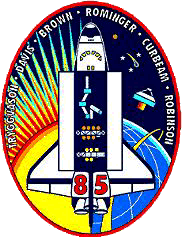
|
Flight Crew
| Nr. |
Surname |
Given name |
Job |
Duration |
| 1 |
Brown |
Curtis Lee, Jr. |
CDR |
11d 20h 28m |
| 2 |
Rominger |
Kent Vernon |
PLT |
11d 20h 28m |
| 3 |
Davis |
Nancy Jan |
MSP |
11d 20h 28m |
| 4 |
Curbeam |
Robert Lee, Jr. |
MSP |
11d 20h 28m |
| 5 |
Robinson |
Stephen Kern |
MSP |
11d 20h 28m |
| 6 |
Tryggvason |
Bjarni Valdimar |
PSP |
11d 20h 28m |
Mission details:
Launch from Cape Canaveral (KSC); landing on Cape
Canaveral (KSC); deploying and retrieval of German-built satellite
CRISTA-SPAS-02; several scientific experiments; tests with Utraviolet
Spectrograph Telescope and Camera; testing tools for ISS (e.g.
Japanese-built robot-arm).
07 August 1997
14:41 GMT. Duration: 11.85 days. Agency: NASA Payload: Discovery F23 / CRISTA-SPAS-2. Perigee: 249 km. Apogee: 261 km. Inclination: 57.0 deg. Period: 89.6 min.
Deployed and retrieved the CRISTA-SPAS-2 (the Cryogenic Infrared Spectrometers and Telescopes for the Atmosphere-Shuttle Pallet Satellite-2) designed to study Earth's middle atmosphere. The CRISTA-SPAS-2 was making its second flight on the Space Shuttle and represented the fourth mission in a cooperative venture between the German Space Agency (DARA) and NASA.
CRISTA-SPAS was deployed by the RMS arm at 22:27 GMT on August 7 and was recaptured by Discovery's RMS arm at 15:14 GMT on August 16. Because of unfavorable weather conditions at the primary shuttle landing site at the Kennedy Space Center, Discovery was waved off for its scheduled August 18 landing. STS-85 landed the next day, at Kennedy Space Center at 11:08 GMT.
Cargo Bay Payloads:
Bay 1-2: External Airlock
Bay 5: MPESS (Multi Purpose Experiment Support Structure) with the MFD (Manipulator Flight Demonstration) payload from the Japanese space agency. This was a 'robot hand' that will be at the end of the robot arm being developed for the Japanese space station module.
Bay 6 Port sidewall: A small carrier with the ITEPC radiation dose counter.
Bay 7: MPESS with the TAS-01 payload (Technology Applications and Science) from NASA-Goddard's Hitchhiker-M program. TAS-01 consisted of several GAS cans with science experiments, including the second flight of the Shuttle Laser Altimeter and an instrument to measure the absolute bolometric flux of the Sun.
Bay 9: ASTRO-SPAS, a free flying platform built by Germany's DASA, carrying the CRISTA-SPAS atmospheric science payload on its second mission.
Bay 11 Port sidewall: a small carrier with the ERPCL transmitter/receiver which communicates with SPAS during its flight.
Bay 12: MPESS with the IEH-2 Hitchhiker payload from Goddard. The International Extreme Ultraviolet Hitchhiker was a joint NASA-Italian astronomy payload. Its two main instruments were the UVSTAR ultraviolet spectrograph and the SEH solar extreme ultraviolet instrument. The MPESS also carried the GLO-5 and GLO-6 airglow studies and the Data-Chaser technology experiment. UVSTAR's main objective is to study the extreme UV emissions from the Io plasma torus around Jupiter.
Bay 13 Starboard sidewall: GABA (GAS Beam Adapter) with two GAS experiment cans, G-572 and G-745. G-572 has experiments from Bellermine College and Utah State, and G-745 has student experiments from Mayo High School.
In-Cabin Payloads: BDS-03; BRIC; PCG-STES-05; ACIS; MSX; SIMPLEX; SWUIS; SSCE.
Developmental Test Objectives
Detailed Supplementary Objectives
Risk Mitigation Experiments
DTO 255: Wraparound DAP Flight Test Verification
DTO 312: External Tank TPS Performance
DTO 700-10: Orbiter Space Vision System Videotaping
DTO 700-12: Global Positioning System/Inertial Navigation System
DTO 700-14: Single String Global Positioning System
DTO 805: Crosswind Landing Performance
DTO 842: AutoTRAC Computer Vision System
DTO 843: V-Bar Proximity Operations Demonstration for ISS
DTO 844: RMS Situational Awareness Displays
DSO 331: Integration of the Space Shuttle Launch and Entry Suit
DSO 484C: Assessment of Sleep Quality and Circadian Rhythms in Astronauts
DSO 485: Intermars Tissue Equivalent Proportional Counter
DSO 493: Monitoring Latent Virus Reaction and Shedding in Astronauts
DSO 802: Educational Activities
RME 1328: Microgravity Vibration Isolation Mount System Performance
Payload And Vehicle Masses: Orbiter (Discovery) empty and 3 SSME's: 69,775 kg; Shuttle System at SRB Ignition 2,047,303 kg; Orbiter Weight at Landing with Cargo 98,847 kg; CRISTA-SPAS 3503 kg; IEH-02 1460 kg; MFD 1647 kg; TAS-01 2516 kg; SWUIS 62 kg.
|
Ref.: #7, #8, #16 - update: 25.03.06
|
Home |